Sanja Matsuri at Asakusa Shrine

The third sunday of May every year, at the Asakusa Shrine (浅草神社 “Asakusa Jinja”), you can experience one of the three biggest Shinto festivals in Tokyo. This weekend, with it’s peak on Saturday May 17th, it is time again for “Sanja Matsuri” (三社祭, lit. “Three Shrines Festival”), an event that is considered the largest and wildest festival!

The festival is held in in honor of the three men that founded the Sensou-ji (浅草寺 “Sensou-ji”), and big parades are held, where three portable shrines, which are referenced in the name of the festival, are the centre of attention, but there are also traditional music and dancing, and over the three days it’s held it attracts millions, tourists and locals alike.
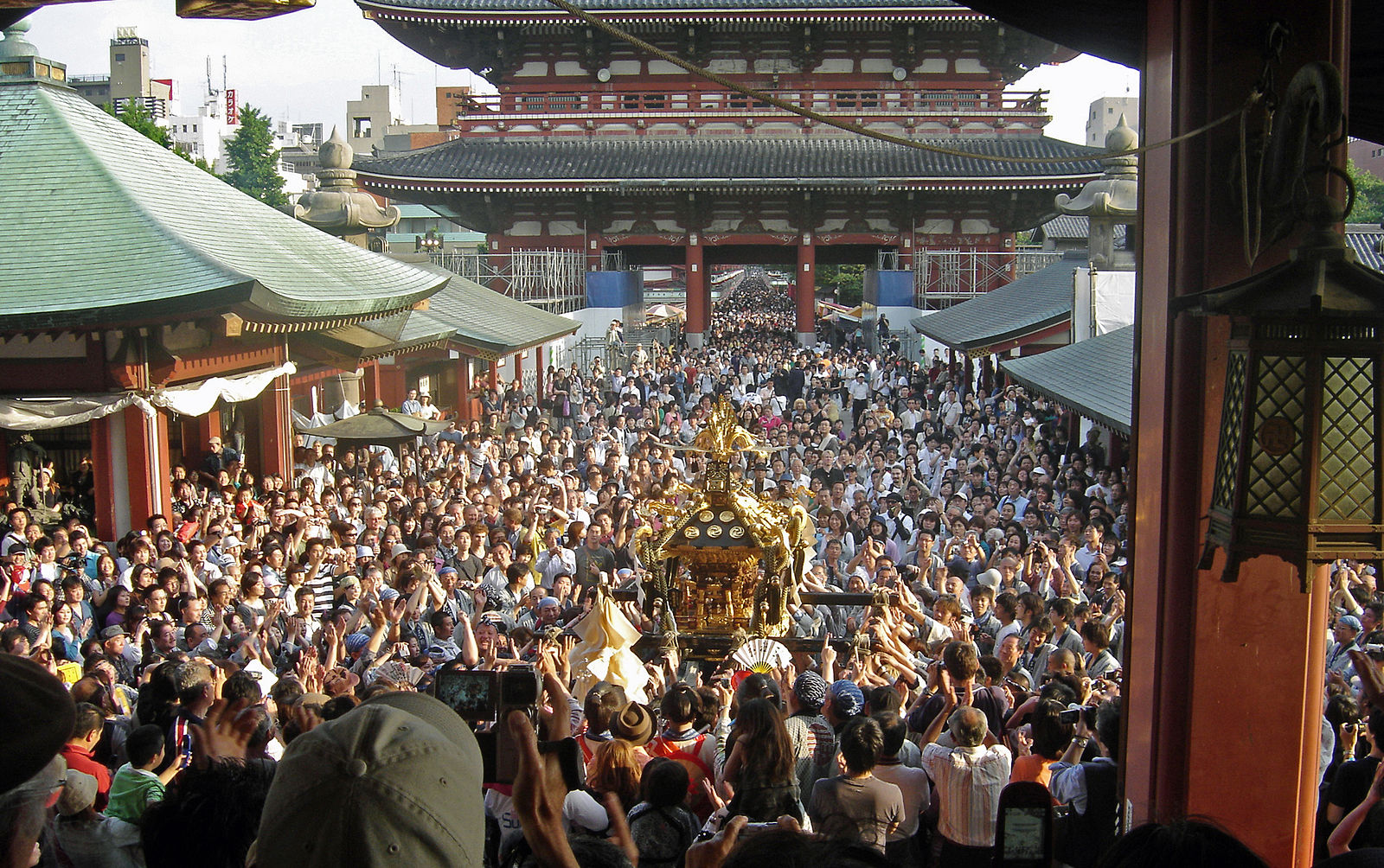
View_of_mikoshi_from_sensoji_Sanja_Matsuri_2006-3

On friday at 1 pm, there is a big parade, and later in the afternoon there will be traditional dancing in the “Haiden” and the “Kaguraden” buildings in the temple grounds.

On Saturday at 12:30 pm there is a large parade with hundreds of local portable shrines, that tour around the town of Asakusa.

On Sunday at 6 am the three main portable shrines start their tour of the local area, and are returned around 8 pm.

If you want to experience Japanese culture, see traditional dancing, listen to traditional music, and maybe get a glimpse of a “yakuza” or two showing of their tattoos, as well as experiencing the biggest festival in Tokyo, this is definitely the event for you.

Classroom Environment

For those of you who are interested in taking a class at Cosmos Japanese Language School, this is what the classroom will look like. It really is a nice, at-home environment and we do our best to keep it that way.

The main classroom

Our bulletin board

KIMONO SALON ♡

We are very excited to share with you this amazing event. Nippon Collection will be holding their first….

KIMONO salon ~for beginners~

10287361_10203699503628994_1945033129_n10270218_10203699503548992_1873685615_n

Date: May 24th (Saturday) & 25th (Sunday)12:00-18:00

(You will be asked to pay a drink fee of 500 yen at the door)

Venue: 105, 3-28-5 Chidagaya, Shibuya-ku, Tokyo

You will get:

→ Cheap but good quality KIMONO and YUKATA (casual type of Kimono for the summer)!
→ One and only Japanese designer’s accessories!

There will be English speaking KIMONO advisers who will help you find the best KIMONO style! You can also chat with everyone over a nice cup of Japanese tea!

Click here for more information → http://www.nipponcollection.com/event-english.html
Or contact Nippon Collection at → info@nipponcollection.com
Click the join button here → https://en.trippiece.com/plans/1513035

Don’t forget to like Nippon Collection’s page on Facebook! https://www.facebook.com/nipponcollection

Koinobori 鯉のぼり

Koinobori, which in Japanese means “carp streamer,” can often be found hanging in front of houses, shops and rivers around this time. These carp streamers that are made by drawing carp patterns on cloth (or paper), are hung to celebrate Children’s Day on May 5th, the last day of Golden Week.

In the past, Children’s Day was actually celebrated to honor boys. The carp was chosen as a symbol for this day because of its strong will and great power to swim up the river, against the flow. Adults hoped that boys would grow to become determined and courageous like carps. On the other hand, Hinamatsuri or Doll’s Day on March 3rd was celebrated to honor girls. Traditionally, on this day, girls would receive dolls that were passed down to their own grandmothers and mothers.

Although there is still a tendency among many Japanese families to celebrate boys on Children’s Day, it has definitely become a more general event for all Japanese children. Happy Children’s Day to all the children in Japan and around the world!

Koinobori made by children from an elementary school near Mitakadai in Tokyo.

Check out this traditional Children Day’s song!

Golden Week

The beginning of Golden Week calls for…..a post on Golden Week!

What is it exactly? Well…..in Japan, around this time we have consecutive public holidays as follows.

April 29th – Showa Day (昭和の日・しょうわのひ・Showa no hi)
May 3rd – Constitution Memorial Day (憲法記念日・けんぽうきねんび・Kenpo kinenbi)
May 4th – Greenery Day (みどりの日・みどりのひ・Midori no hi)
May 5th – Children’s Day (こどもの日・こどものひ・Kodomo no hi)

Many Japanese people effectively use their paid time off before and after these public holidays so that they will have a longer break. This is what we call Golden Week.

Golden Week along with the New Year holiday in January and the Obon holiday in August is probably the only time an average working Japanese person can enjoy a nice vacation. However, it can be difficult to plan a getaway because during this time, hotel prices and flight tickets to popular destinations soar to more than twice the usual amount and even if you can afford to go somewhere, it will probably be fully booked. Luckily, most stores, especially in big cities, continue to run to cater to those who decide to remain at home.

A few years ago, the Japanese government along with big Japanese companies started to consider shifting the period of Golden Week according to region. However, since there has not been any news coverage on this this year, it seems they have not come to a conclusion yet.

What will you be doing during Golden Week this year?

There are plenty of events within the Kanto region for those of you staying at home. Why not check one out?


The Book of Tea

20140424-165140.jpg
The Book of Tea written by Kakuzo Okakura (or Okakura Tenshin, as he is known in Japan) is a beautiful book about the spirit of chanoyu (the practice of Japanese tea ceremony).

This book was first published in English in 1906, not long after Japan surprised the world by defeating Russia in the Russo-Japanese War that ended in 1905. It is said that Okakura wrote this book in an attempt to expose to the West a more delicate and traditional side of Japan and to show that despite Japan’s rapid modernization and growing economic and military power, Japan was and still is an aesthetically beautiful nation.

Although Japanese tea ceremony today is mostly practice by women, it is originally and traditionally a practice that the samurai warriors engaged in. Through this book, Okakura provided the West with an alternative vision of Japanese warriors and also for modernized Japan, which at that time was striving to become like the “masculine” West.

Today, even 100 years after this book was published, people still turn to this book to learn about Japanese cultures and values. Although times have definitely changed and the practice of tea ceremony itself may not be as common and popular anymore, this book continues to provide an insight of the way Japanese people perceive beauty.

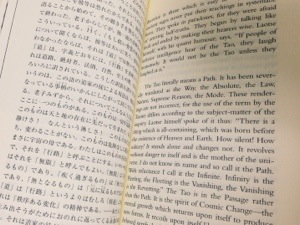
This version of “The Book of Tea” that we have in our library is also perfect for those who are studying Japanese as it is written in both Japanese and English. When you open a page, you will find the Japanese translation on the left and the original passage written in English on the right. How convenient!

20140424-165144.jpg

Bushido – The Soul of Japan

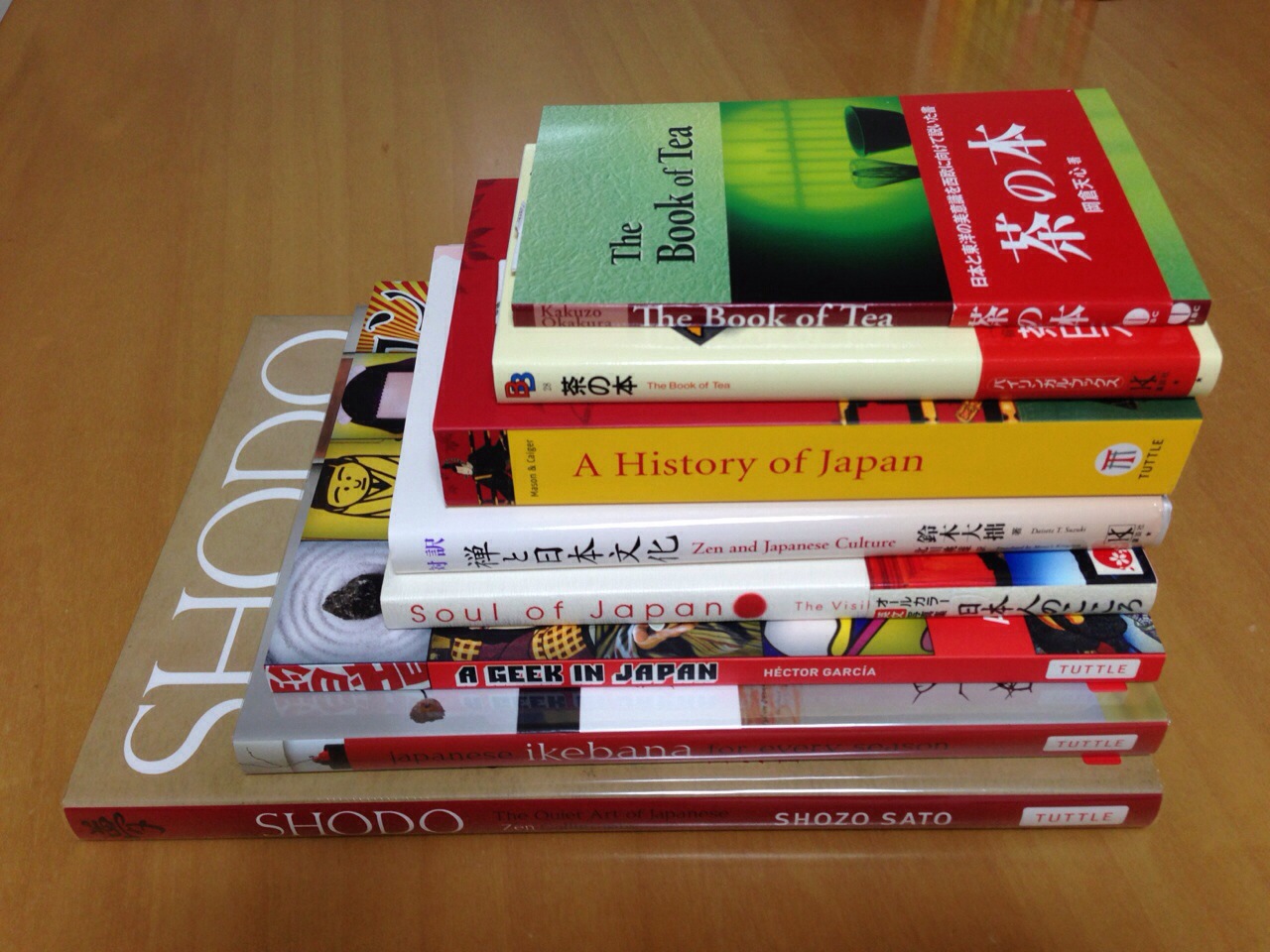
Starting from today, we will be introducing the books that we are available in our mini-library. We recently bought a number of Japan-related books and we hope that we can slowly add more to our collection. If you have any books that you would like to recommend to us (related to Japan of course!), please let us know through g-mail, twitter or facebook!

Today we will be introducing the book:

photo

“Bushido – The Soul of Japan”

by Inazo Nitobe

If you have watched “The Last Samurai” or any other movie related to samurais and samurai culture, you probably have heard the characters mention at some point, the idea of bushido.

Bushido which implies “the way” of the samurai life is similar to the term “chivalry,” in that they both refer to a warrior’s moral code of conduct.  However, the Japanese bushido is slightly more complicated and particular.

The seven virtues of bushido, according to Inazo Nitobe are:

  • Justice – 「儀」 (ぎ・gi)
  • Courage – 「勇」 (ゆう・yu)
  • Benevolence – 「仁」 (じん・jin)
  • Politeness – 「礼」(れい・rei)
  • Sincerity- 「誠」 (まこと・makoto)
  • Honor- 「名誉」 (めいよ・meiyo)
  • Loyalty – 「忠義」 (ちゅうぎ・chugi)

In this book, Nitobe first thoroughly examines each of these virtues. He then goes on to explain how these virtues are strongly rooted in Japanese society and provides his insight on the future of bushido.

It is interesting to note that Inazo Nitobe, who was an educator and civil servant to the Meiji government, wrote this book in English in 1900. Like Tenshin Okakura, who wrote “The Book of Tea” first in English as well, he hoped that he could be some kind of bridge between Japan and the West. Since Japan at this time was rapidly Westernizing and constantly trying to promote itself as a modernized nation like the West, books such as “Bushido” and “The Book of Tea” were read with great fascination as it exposed the more traditional and delicate side of Japanese culture.

Students of COSMOS may borrow this book and any of the other books in our collection 🙂

If you are looking for a Japanese language school, sign up for a free trial!

  • We do not ask for any material fee or registration fee.
  • If you have your own material that you would like to continue studying, you can bring that along.
  • If you do not have a specific textbook/curriculum in mind, you can tell us what you would like to improve (writing, speaking, reading etc.) and what you are interested in and we will plan a curriculum that fits your needs.
  • You can come for class several times a week or once every two, three weeks.

It really is a great environment for anyone who wants to learn Japanese!

Free trial lesson

Free Trial!!!