Tsukuyomi – The God of the Moon

Over the last two weeks we have written about Amaterasu, the goddess of the sun, and Susanoo, the god of storms and the seas. Time has come for the last of the “Big Three” in Shinto: Tsukuyomi – the God of the Moon.

Tsukuyomi (月読) is a compound of “tsuku” 月 (meaning “moon, month” and is today read as “tsuki”), and “yomi” 読 (meaning “to read”). However there are sources that gives another spelling of his name, like the Nihon Shoki. There it is written 月弓 “tsukiyumi”. However, it is thought that the reading “tsukiyumi” is only a variation of the pronunciation, which has led to this alternate spelling.
Another interpretation is that it might be “tsukiyo” 月夜 (“moonlit night”), and “mi” 見 (“seeing, watching”).

Tsukuyomi differs a little from the moon-gods of ancient Greece and Rome in that he is a male. This is seen in the old sources such as the Kojiki and Man’yôshû, where he is sometimes mentioned with the suffix “-otoko” 〜士 (“man, gentleman”).
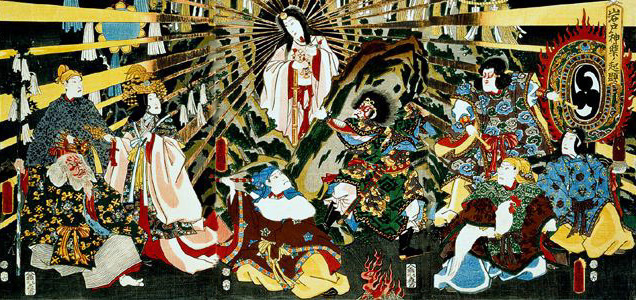
Amaterasu emerges from the cave, with the other gods gathered to cheer her up. (Photo courtesy of Wikipedia)

Amaterasu emerges from the cave, with the other gods gathered to cheer her up. (Photo courtesy of Wikipedia)

As mentioned before, Tsukuyomi is the brother and husband of Amaterasu, and brother to Susanoo. They were born when their father Izanagi was purifying himself after having been through the underworld. Tsukuyomi was born out of Izanagi’s right eye. Tsukuyomi was the second god to appear, following his sister Amaterasu, and before Susanoo.

“Wait, the god of the moon, and the goddess of the sun are married? Why are they not together in the skies then?” you might be thinking. Well, one day Amaterasu was invited to a feast, but could not attend. So she sent her husband instead. The feast was presented by the goddess of food: Uke Mochi. When everyone had arrived, and the feast started, Uke Mochi turned to the sea and spat out fishes. Then she turned to the forest she spewed out wild game. And finally, she turned to the rice fields and coughed up rice. Tsukuyomi thought the food looked delicious, but he was so disgusted with how Uke Mochi had produced the food that he killed her. When Amaterasu, the goddess of the sun, found out about this, she was so angry that she never wanted to see him again. So she is forever making sure to move to the other side of the sky, separating day from night.

And this ends our series on the “Big Three”. Whenever you look up in the sky and see the sun, or the moon, or feel the breeze on your skin, you know that the ancient Japanese were thinking about these gods and goddess. And they are fickle, and wild gods, with short tempers, and full of “human” flaws. Much like the mythology of Greece, or the Norse gods. However, they give us great stories even to this day. ^_^


P.S. The Japanese aren’t to fond of depicting the God of the Night, so it was hard to find pictures that wasn’t from a game, anime, manga, or Amaterasu or Susanoo.

Susanoo – The god of Seas and Storms

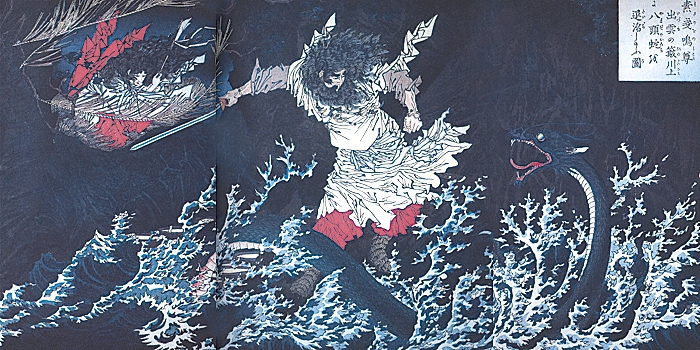
Susanoo and the Water Dragon, by Utagawa Kuniyoshi. (Photo courtesy of Wikipedia)

Susanoo and the Water Dragon, by Utagawa Kuniyoshi. (Photo courtesy of Wikipedia)

Last week we talked about Amaterasu – the godess of the Sun, and the main diety of the Shinto religion. In that text we also mentioned her brother and husband Tsukiyomi (the God of Moon and Night). Today we take a closer look at her other brother: Susanoo.

Susanoo (須佐之男) is the Shinto god of seas and storms. He is also known as “the Powerful Storm of Summer”. As we mentioned in the post about Amaterasu, she and her brothers were born when their father Izanagi purified and washed himself after having gone through the underworld. Amaterasu and Tsukiyomi were born out of Izanagi’s left and right eye respectively, and Susanoo was born from the nose. Susanoo also had a famous sword known as Totsuka-no-Tsurugi (十拳剣 “Sword with a length ten times it’s handle”), or also called Orochi-no-Aramasa (蛇之麁正).

As with most of he stories about the Shinto gods, the oldest sources are the Kojiki (古事記) and the Nihon Shoki (日本書紀). These two chronicles speak of a long-standing rivalry between Susanoo, and his sister Amaterasu (like with most brother-sister relationships, perhaps?). One day, Susanoo was told to leave heaven, and before leaving he went to bid his sister farewell. She was suspicious of Susanoo’s motives, and in order to convince her about his sincerity, Susanoo challenged her to a bet. They each took one thing from the other, and from that object they summoned new gods and goddesses. Amaterasu created 3 goddesses out of Susanoo’s sword, and Susanoo created 5 gods from Amaterasu’s neckless. Amaterasu then claimed that the 5 gods were hers, because they come from her neckless, she thought she had won, but Susanoo then claimed himself the winner as his sword had created goddesses.

Susanoo and Yamata-no-Orochi (Picture courtesy of Wikipedia)

Susanoo and Yamata-no-Orochi (Picture courtesy of Wikipedia)

Another story about the relationship between the two sibling gods is one where Susanoo grows restless, and in a fit of rage goes berserk. While wrecking havoc upon everything around him, he destroys Amaterasu’s rice fields, and killes her servants, among other things. This causes Amaterasu to go and hide in a cave for some time, and there is no sun. In the end she is persuaded to come back out, and Susanoo is banished from heaven, and he traveled to the province of Izumo, in the east part of today’s Shimane Prefecture.

Here he meets a family, headed by an old man by the name of Ashinazuchi, who tells Susanoo about the eight-headed, and eight-tailed, snake called Yamata-no-Orochi (八岐の大蛇). The family used to have 8 daughters, but the snake had eaten all but one, and he was soon coming back for her. Susanoo decided to help the family, if he was allowed to marry the last daughter: Kushinada-Hime. They married, and Susanoo turned her into a comb, to be able to have her close to him while battling the giant snake.

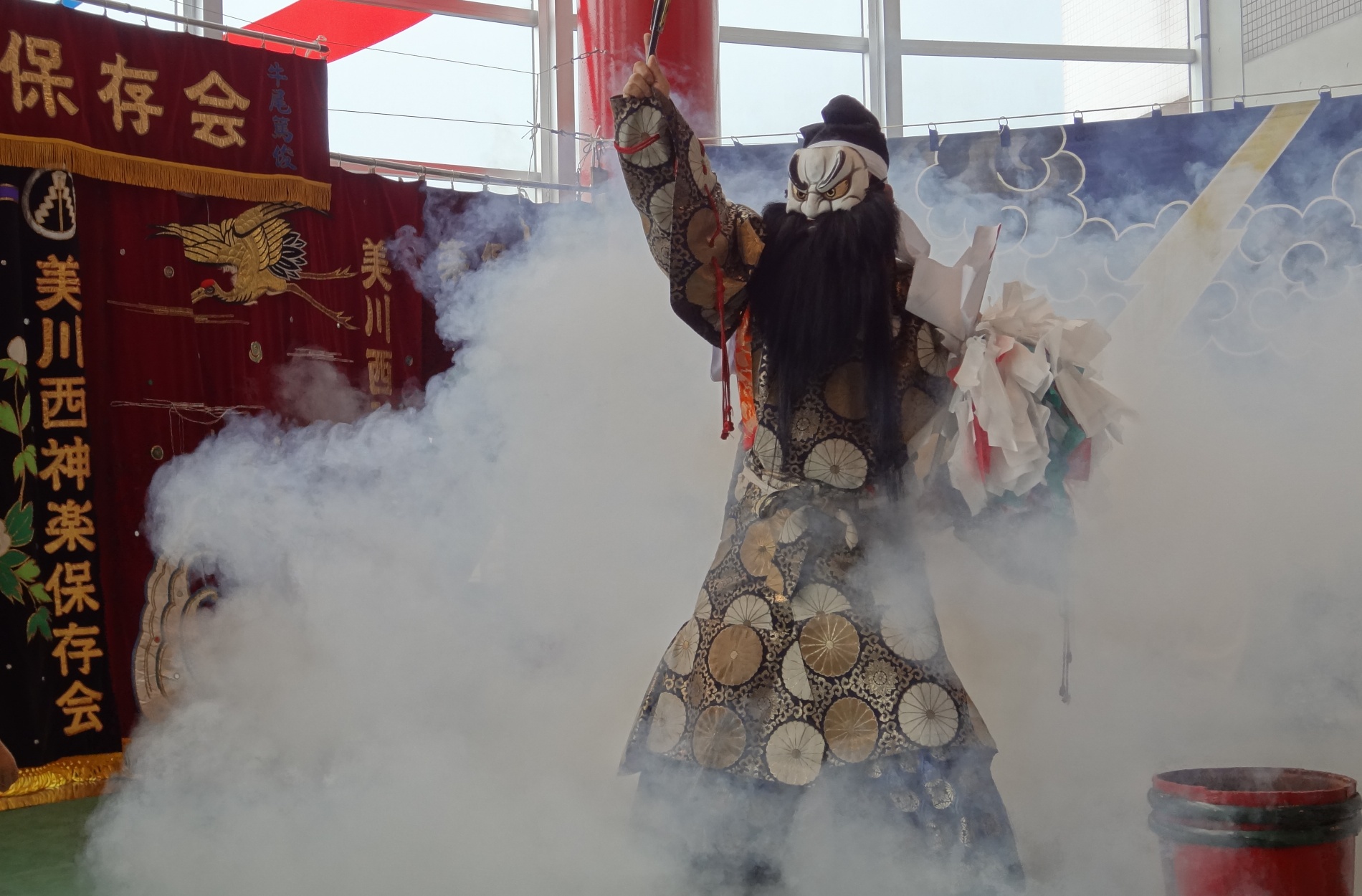
Susanoo as portrayed in the Kagura (sacred dance) "Orochi" (Picture courtesy of Wikipedia)

Susanoo as portrayed in the Kagura (sacred dance) “Orochi” (Picture courtesy of Wikipedia)

He built a huge fence, with eight gates in it. Behind each gate he placed a huge barrel of sake. When the snake came, he put one head through each of the gates, and drank the sake, and fell asleep. While being knocked out, Susanoo could easily cut of the heads of the snake, and its tails. And in the forth tail, he found a sword, that he would later give to Amaterasu as a reconciliation gift, and be allowed back into heaven. This sword later became known as the Kusanagi-no-Tsurugi (草薙の剣), and is one of the Japanese Imperial Regalia.

In popular culture, Susanoo can be found in many different games, mangas, and animes: In “Naruto”, the Uchiha family can use their strongest ocular power, the Mangekyo Sharingan, to summon a powerful diety named Susanoo; in the video game “Puzzle & Dragons”, Susanoo is a collectible god; in the video game “Okami” he is one of the protagonists; he showed up in the card game “Android: Netrunner” from Fantasy Flight Games; and he appears in the tabletop roleplaying game “Scion”.

As you can see, Susanoo is a rough, wild character, who isn’t even afraid of his sisters wrath, and who carries out both great deeds of heroism, as well as acts of vandalism. A great warrior, well worthy the title God of Seas and Storms.

"Nihon ryaku-shi", where Susanoo is depicted.

“Nihon ryaku-shi”, where Susanoo is depicted.

Super Sentai – スーパー戦隊

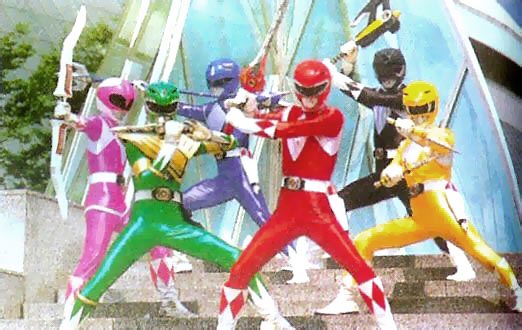
The Kyôryû Sentai Zyuranger, that became Power Rangers in America. (Photo courtesy of power ranger.wiki.com)

The Kyôryû Sentai Zyuranger, that became Power Rangers in America.
(Photo courtesy of power ranger.wiki.com)

Last week we talked about Kaiju (怪獣) movies, or Monster movies, with monsters like Godzilla, Rodan, and Gamera. We also mentioned in that post that the Kaiju genre is a form of Tokusatsu movies. Tokusatsu (特撮) means “special photography”, and the name refers to movies with a lot of special effects in them. This week we return to this type of movies, to look at a different genre: the Super Sentai Series!

Super Sentai Series (スーパー戦隊シリーズ) got it’s name from the Mechas, or Super Robots, that the heroes commonly use, and from the Sentai (戦隊) which means “task force”, or “fighting squadron”. There are two more genres in Tokusatsu, which are related to the Super Sentai in style, and they are the Ultraman Series, and the Kamen Rider Series. We will come back to these in the future.

Denji Sentai Megaranger. (Photo courtesy of Wikipedia)

Denji Sentai Megaranger. (Photo courtesy of Wikipedia)

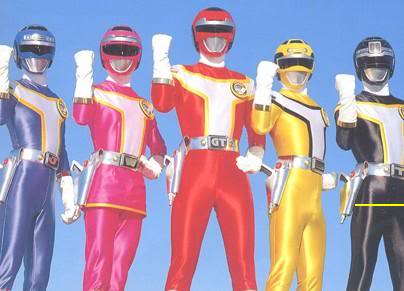
The typical format of a Super Sentai Series is the illustration of the fight between good and evil. The good side usually consists of 5 people, but sometimes less than that. These heroic main characters receive super powers, in one way or another, which can be magical or technological in nature. And they are easily recognised by their characteristic colour-coded uniforms, with red, blue, black, yellow, and pink as the most common colours. They usually fight with advanced weapons, martial arts skills, and with robots/mechs against the forces of evil.

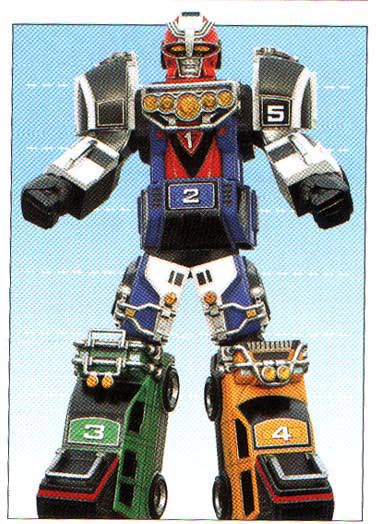
Speaking of which, the forces of evil are usually threatening to conquer or destroying the world. Every week the heroes will have to fight through an army of underlings, and a “monster of the week”. This monster fight is usually not an easy task, and usually ends up in the monster transforming into a giant version, forcing the heroes to assemble/transform their robots into an equally big version, and the fight continues, until our heroes win.

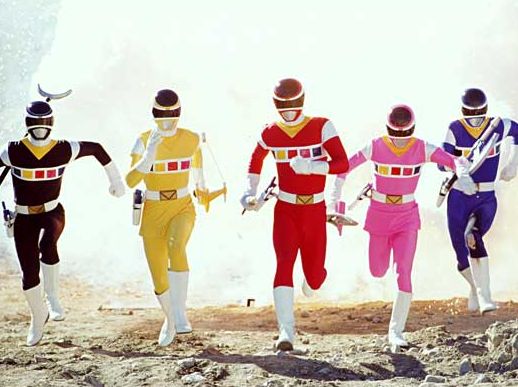
Kousoku Sentai Turboranger. (Photo courtesy of http://www.jefusion.com)

Kousoku Sentai Turboranger. (Photo courtesy of http://www.jefusion.com)

The many different Super Sentai Series have been somewhat distributed outside of japan, with France, Spain, Portugal and Brazil airing a few of the earlier series in the 70’s and 80’s. Hawaii has seen a long tradition of airing the series’ on Hawaiian television, in its original Japanese, with English subtitles. Sacramento, Los Angeles and the California area has also had a few series shown on local television.

Ressha Sentai ToQger. (Photo courtesy of www.orendsrange.com)

Ressha Sentai ToQger. (Photo courtesy of http://www.orendsrange.com)

There have been 38 different Super Sentai Series’, and I won’t list them all here. I will mention a few that usually stands out in each decade:

  • Battle Fever J (70’s)
  • Choudenshi Bioman (80’s)
  • Chikyuu Sentai Fiveman (90’s)
  • Kyôryû Sentai Zyuranger (90’s) (which became Power Rangers under Saban Entertainment)

The list can be made much longer, and there are tonnes of movies, OVAs, and other productions besides the series. And since the Super Sentai phenomenon has been around since the 70’s, it has shown up in many other places, such as video games, game shows, and other television shows. There has also been a lot of parodies and spoofs (one funny one in particular you find Here!).

So why not grab your colour-coded jump-suit and helmet, and head into this fascinating part of Japanese culture? Who needs anime, when you can fight guys in rubber suits? ^_-

The RV Robo from Gekisou Sentai Carranger. (Photo courtesy of powerranger.wikia.com)

The RV Robo from Gekisou Sentai Carranger. (Photo courtesy of powerranger.wikia.com)

Amaterasu – The Japanese Sun Godess

Amaterasu emerges from the cave. (Photo courtesy of Wikipedia)

Amaterasu emerges from the cave. (Photo courtesy of Wikipedia)

As you might already know, in Japan there are two main religions: Buddhism and Shintoism. The lines between these two religions are sometimes very blurred, and it’s hard to distinguish what part of a tradition comes from where. And at other times it is clear as day. One thing that is clear is the gods, or Kamis, of Shinto, with their leader at the top: Amaterasu (天照), or Amaterasu Ômikami (天照大神).

The name Amaterasu can be translated into “shining in heaven”, and Amaterasu Ôkami can be translated to “Great Kami that shines in heaven”, and is a more than fitting name for the Shinto deity of the Sun and the Universe. It is also believed that the Emperors of Japan have all been direct descendants from Amaterasu.

The oldest stories of Amaterasu can be found in the Kojiki and the Nihon Shoki (the two oldest records of Japanese history). She is the sister of Susanoo, the god of storms and the sea, and of Tsukuyomi, the god of the moon and the night. These three siblings were all born of a higher deity named Izanagi-no-Mikoto (one of the Gods that is said to have created the islands that today make up Japan) after he had been through the Underworld. While purifying himself, Amaterasu was born when he washed out his left eye, Tsukuyomi was born from the washing of the right eye, and Susanoo from the washing of the nose.

Amaterasu and other Kamis (Photo courtesy of Wikipedia)

Amaterasu and other Kamis (Photo courtesy of Wikipedia)

It is believed that Amaterasu and her brother (and husband) Tsukuyomi, the god of the moon and night, where to rule the heavens together. However, one day Tsukuyomi killed the god of food, Uke Mochi, because he was disgusted with how she produced the food. (She either threw it up, or blew it out of her nose.) When Amaterasu found out what her brother had done, she refused to look at him, and labeled him as an evil god, and split night from day.

Amaterasu also bickered and fought with her other brother Susanoo a lot. One event that is told about is when Susanoo became restless and decided to go on a rampage. This rampage led to Susanoo destroying Amaterasu’s rice fields, killing her servants, and throwing a horse into her loom. Amaterasu, full of fury and grief, decided to hide in a Ama-no-Iwato (天岩戸, “the heavenly cave”), and there was no sun anymore. Not until the rest of the Kamis had managed to cheer her up again, and Susanoo apologising to her by giving her the sword Kusanagi-no-Tsurugi (one of Japan’s Imperial Regalia), did she decide to come back out, and the sun was back. (According to some stories, the famous Onmyodo practitioner Abe-no-Seimei also helped cheering up Amaterasu.)

The temple for worshiping Amaterasu is in Ise, in Mie Prefecture. It is said that the three Regalias of Japan, the mirror, the jewel, and the sword, are all housed at this shrine.

Amaterasu from the game "ôkami" (Photo courtesy of http://okami.wikia.com, all rights reserved by Capcom)

Amaterasu from the game “ôkami” (Photo courtesy of http://okami.wikia.com, all rights reserved by Capcom)

Since Amaterasu is one of the three main Kamis in Japanese culture, she has also been the inspiration on popular culture. Her name appears as a fire technique in “Naruto”, and in “One Piece”. There are cards named after her in “Yu-Gi-Oh” and “Cardfight!!! Vanguard”. And the Capcom game “Ôkami” has Amaterasu herself as the protagonist, in her wolf-shape. Even the Canadian/American Sci-Fi-series “Stargate SG-1” has Amaterasu as a minor antagonist.

The sun has played a big role in many religions and cultures, and as you can see Japan is no exception. So next time you are outside and feel the warm sun on your skin, it might just be Amaterasu showing her warmth. ^_^

Kaiju – 怪獣

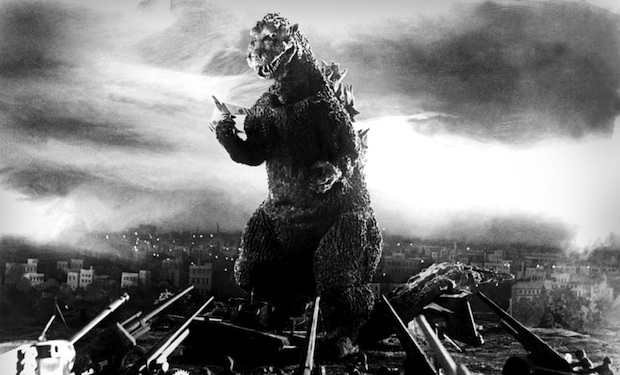
Godzilla 1954

Godzilla in the 1954 film

With the premiere of the new Godzilla (or rather ゴジラ) movie in recent memory, and the popularity of Pacific Rim the other year, we take a look at the “giant monster” genre, that is starting to become more and more popular in western cinema. But what is a Kaiju actually?

f6bfb655a06dcee0610f1bb78cafa1771257f791.26.2.2.2

Rodan (ラドン) from his 1956 film

The Japanese word “怪獣 (kaijû)” is translated to “giant beast” in English, but has also been defined as “strange monster”, and refers to a whole genre known as Tokusatsu (特撮). Kaiju films usually show monsters of different forms, usually attacking a major Japanese city or engaging another monster, or sometimes several other monsters, in battle.

Normally, the Kaiju monsters are based on normal animals or insects, but sometimes also on mythological creatures. However, there are also cases where inanimate objects such as traffic lights, tomatoes, and umbrellas have inspired Kaijus. In English the term Kaiju is usually used to refer to Japanese monsters in Japanese folklore, and in the Tokusatsu movies. However, the Japanese use of the word actually also include vampires, ware wolfs, and other “western” monsters/creatures as well.

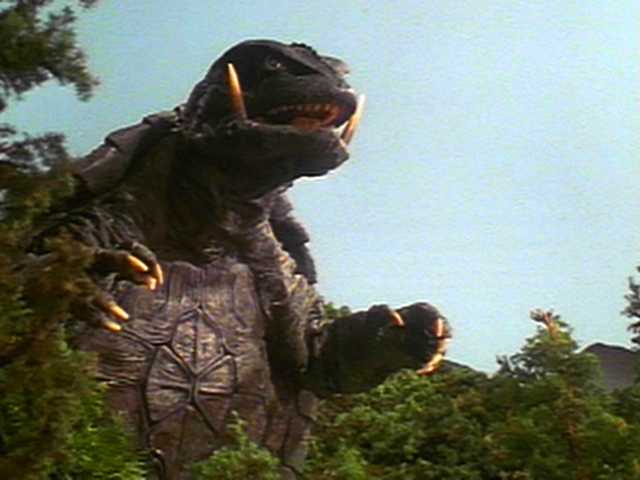
Gamera13

Gamera, a Kaiju from Daihei Studios, and sometimes seen as a rival to Godzilla (from Toho Studios).

Kaijus have been portrayed in many different ways: as minions or side-kicks to the main antagonist, a pure force of nature, as helpers to the hero, or as heroes themselves. For example, the most famous, and widely known Kaiju is unarguably Godzilla, or Gojira (ゴジラ). Godzilla has been playing almost every role possible, and have those around him react accordingly depending on how he was presented in the film.

Other notable Kijus are Mothra, Rodan, Gamera, King Ghidorah, and Daimajin (a humanoid kaiju, or kaijin “怪人”)

“Omotenashi” & “Honne/Tatemae”

Today we take a closer look at two concepts that is very Japanese. Let’s learn about Japanese “service”, and how the Japanese are split between what they want, and what is expected.

“Omotenashi”

The word ‘Omotenashi’ in Japanese comes from omote (面 “surface”) and nashi (無し “less”), which means “single-hearted”, and also mote (持て “carry”) and nashi (為し “accomplish”), which means “to achieve”. Therefore, Omotenashi has two meanings, which include offering a service without expectation of any returned favour, and the ability to actualise that idea into an action.

Interestingly, the Japanese language makes no distinction between ‘guest’ and ‘customer.’ In English, the concept of ‘service’ suggests a hierarchy between the ‘server’ and the ‘customer.’ The Japanese Omotenashi, however, is based on a non-dominant relationship between equals – between the person offering the service (the host) and the person receiving it (the guest or customer).


“Honne” vs “Tatemae”

Honne and tatemae are Japanese words that describe the contrast between a person’s true feelings and desires (本音 “honne”) and the behavior and opinions one displays in public (建前 “tatemae”, “façade”).

Honne may be contrary to what is expected by society or what is required according to one’s position and circumstances, and they are often kept hidden. Tatemae is what is expected by society and required according to one’s position and circumstances, and these may or may not match one’s Honne.

The notion of Honne and Tatemae is seen by some as a cultural necessity resulting from a large number of people living in a comparatively small island nation. Close-knit co-operation and the avoidance of conflict are considered to be of vital importance in everyday life.

Even though there might not be direct single word translations for honne and tatemae in some languages they do have two word descriptions. For example in English “private mind” and “public mind.” Some researchers suggest that the need for explicit words for Tatemae and Honne in Japanese culture is evidence that the concept is relatively new to Japan, where as the unspoken understanding in many other cultures indicates a deeper internalization of the concepts.

The conflict between Honne and Giri (“social obligations”) is one of the main topics of Japanese drama throughout the ages. For example, the main character would have to choose between carrying out his obligations to his family or his feudal lord, or pursuing a stealthy love affair.

Awa Odori (阿波踊り)

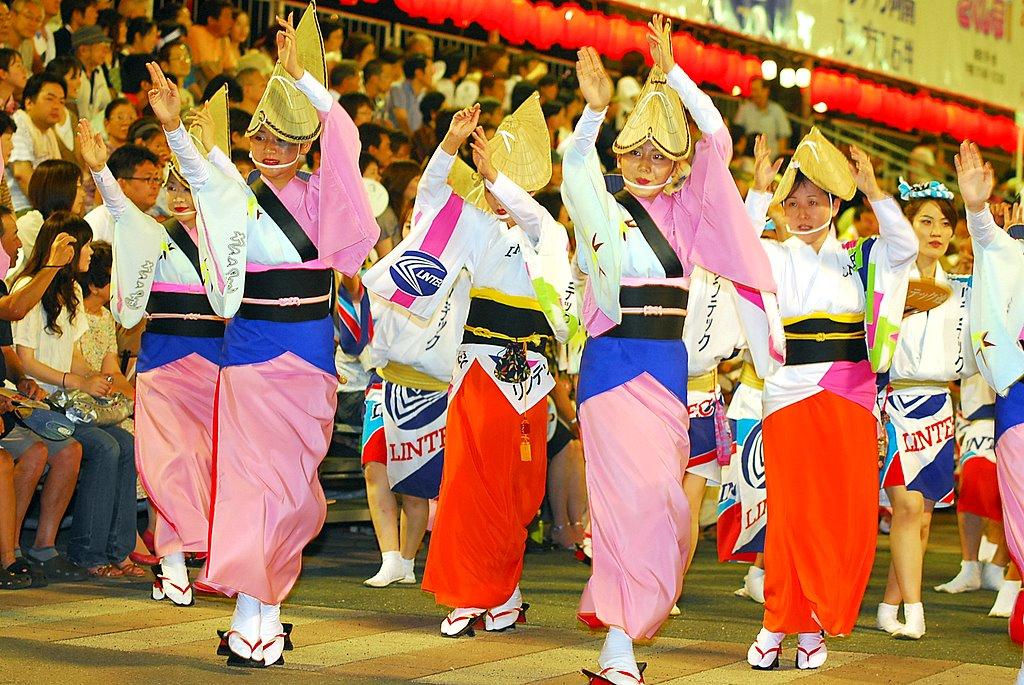
Awa Odori in Tsukishima (photo courtesy of Wikipedia)

Awa Odori in Tsukishima
(photo courtesy of Wikipedia)

Between the 12-15 August, in Tokushima Prefecture (徳島県) on Shikoku Island (四国), and part of the Obon celebrations, Awa Odori (阿波踊り) is held, and is ranked as the largest dance festival in Japan. “But, why are you writing about this now? I wanted to see that!” you might be yelling at the screen. Just stay calm, because the second biggest Awa Odori event in Japan is held in Koenji (高円寺) in Tokyo in late August every year. So it is just in the right time. 🙂

So what is Awa Odori? And where does it come from? Well, as with other Japanese dancing, groups of choreographed dancers and musicians dance through the streets, usually accompanied by Shamisen, bells, flutes, and Taiko drums. “Awa” (阿波) is the old feudal administration name for Tokushima prefecture, and odori (踊り) means dance.

The earliest origins for Awa Odori is the dances that Buddhist priests performed during the Kamakura Period (1185-1333). However, the modern dance grew out of the traditional dance of Obon, the Buddhistic festival of the dead where it is believed that the spirits of deceased ancestors come to visit. The term “Awa Odori” was first used in the 20th century, but even before that, the Obon celebrations in Tokushima was notorious for their size, exuberance, and anarchy since the end of the Sengoku Period (戦国時代).

Dance of Fools (photo courtesy of Wikipedia)

Dance of Fools
(photo courtesy of Wikipedia)

During the daytime a restrained dance called “Nagashi” (流し) is performed, but at night the dancers switch to a frenzied dance called “Zomeki” (騒き).

Men and women dance in different styles. For the men’s dance: right foot and right arm forward, touch the ground with toes, then step with right foot crossing over left leg. This is then repeated with the left leg and arm. Whilst doing this, the hands draw triangles in the air with a flick of the wrists, starting at different points. Men dance in a low crouch with knees pointing outwards and arms held above the shoulders. The women’s dance uses the same basic steps, although the posture is quite different. The restrictive kimono allows only the smallest of steps forward but a crisp kick behind, and the hand gestures are more restrained and graceful, reaching up towards the sky. Women usually dance in tight formation, poised on the ends of their geta sandals.
Video for men’s dance: https://www.youtube.com/watch?v=olv-QhjvrmY
Video for women’s dance: https://www.youtube.com/watch?v=aLJNiAQgjWM
(
The videos are in Japanese, but the instructions given are pretty much the same as in the text above. Just watch and follow along. ^_^ )

In May 2015, Japanese production company Tokyo Story will produce a substantially big version of Awa Odori in Paris by bringing there hundreds of dancers from Japan. “Awa Odori Paris 2015”, as the event is called, would reproduce the “fever” of Awa Odori. This event will be a first step to promote Awa Odori and the Japanese “matsuri” culture abroad.

I don’t know about you guys, but I really want to get dancing right now! “Yattosa! Yattosa!” (^_^) Keep your eyes peeled for info about Awa Odori in Kouenji in our events page, or search for local events. See you in the crowd, perhaps!

Awa Odori dancers.

Awa Odori dancers.

We are back from a short Summer Holiday

Cosmos Logo New

Hello out there!

Maybe you have been wondering where the updates have been the last week? Well, we have had a short summer break, but now we are back in full swing.

We have passed the mid-point of August, and we will update with some events happening in the Tokyo are during the second half of August. We will also continue to post about culture, language, and other interesting things.

So let’s enjoy the rest of the summer together.

Kind Regards
The Cosmos Tokyo Staff

Gundam – “The Star Trek of Japan”

IMG_2570

The RX-78-2 Gundam, life-sized statue in front of Diver City mall in Odaiba, Tokyo

After reading the title you might be going “Hang on a sec!! Isn’t Gundam an anime about giant robots and war? Kinda exactly the opposite to what Star Trek is about?” Well, I see you already know a bit about Gundam then, but hear me out. ^_^

Gundam is, as we mentioned above, an anime about giant robots used instead of tanks in battles. The original anime is from 1979, and tell a story about how humanity has spread out into space, and are now populating space colonies. Some of these colonies join together as the Principality of Zeon, and start a battle for independence from the Earth Federation. This war claims almost half of the population on both sides, and quickly end up in a stalemate. It is in this stalemate that we are introduced to the main characters, and the anime Mobile Suit Gundam starts of.

The RX-78-2 Gundam watching over Tokyo

The RX-78-2 Gundam watching over Tokyo

After the original anime, several other animes, as well as spin-off work, has been produced, and the story is either built on further, or set in parallell universes with different stories, but all connected in that they use “mobile suits” and that the “Gundam” suit is in there somewhere.

“Well, that is nice and all, but how is this related to Star Trek?”, I hear you ask. Well, in the west we have Start Trek to thank for a lot of influences in our culture and in our technological advances: Such as the first space shuttle being named “Enterprise” after the space ship in the series and the films, the design of Palm PDAs and mobile phones, as well as Google Earth being inspired by the Tricorders mapping ability in the series. In the same way, Gundam has had a major cultural impact in Japan: Japanese Self Defence

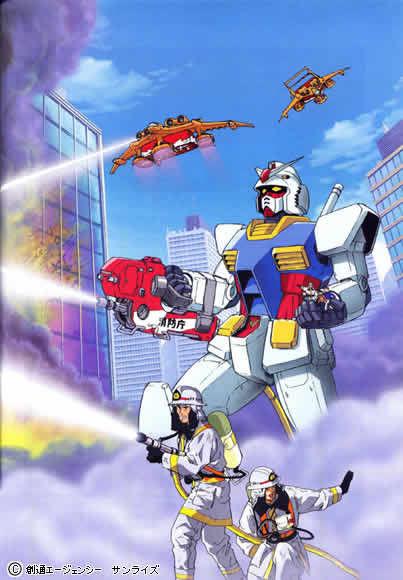
A poster for the Japanese Firefighting corp, with the help from Gundam.

A poster for the Japanese Firefighting corp, with the help from Gundam.

Force code-named its developing advance personal combat system as Gundam, the Mitsubishi Lancer Evolution appearance is influenced by the Gundam mobile suit, and some products have special “Char Custom” editions in Japan, which are normally a red version of a product, imitating the custom red mobile suit, used by Char Aznable, a Zeon faction main character in the first few Gundam series. Such examples include a red Nintendo Gamecube and Game Boy Advance SP.

So whether you are a Gundam fan or not, it is still a huge staple in the current Japanese culture. And if you are a Gundam fan, or want to become one, or just want to know more, I can recommend the animus, but also a visit to Odaiba, Tokyo. Here you can see a life-sized statue of the titular mobile suit in front of the Diver City mall. And on the 7th floor of the mall you can either visit the figure shop, the clothes shop, or experience the Gundam Universe even more in Gundam Front Tokyo.

IMG_2586 IMG_2580

IMG_2587

So why not get more acquainted with the Gundam universe, and take a trip to Odaiba while you’re at it? ^_^